


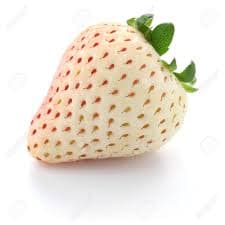
Cultivated on Shikoku and selected for honey-sweetness over size. Barely acidic, intensely hydrated — bite into one and the juice runs down your wrist. A quieter, more elegant Japanese strawberry than the Okimi headliner, and the one many Japanese eaters quietly prefer.
Ripening & storage
Non-climacteric — eat as-is- Ripeness cue
- Coral-pink to deep red; berries hold their shape firmly.
- Storage
- Fridge immediately; eat within 2–3 days.
About Awa Strawberry
The Awa strawberry is a Tokushima-grown cultivar from Shikoku, the smallest of Japan's four main islands. The Awa region built its reputation on indigo dye and high-end strawberries, and the local growers select Fragaria × ananassa cultivars for honey sweetness rather than the show-stopping scale of the Miyazaki Okimi.
Each berry is medium-large, deep red, with a soft glossy skin that gives slightly under finger pressure. The flavour is the point — densely sweet, low-acid, with a real honey backbone and a juice content that runs down your wrist on the bite. Aroma is more delicate than the Okimi, less perfumed, more clean fresh strawberry.
Serve slightly chilled, within 24 hours of arrival. No washing beyond a light pat. Pairs naturally with cream, with shortcake, or eaten as-is alongside green tea. Like all premium Japanese strawberries, treat them as a finished product, not an ingredient.
Did you know?
- The commercial strawberry is a hybrid first bred in Brittany in the 1750s from a Virginian and a Chilean species.
- Japanese breeding programmes run regional cultivars like Awa, Amaou, Tochiotome and Benihoppe — each paired to a prefecture's climate.
- A single strawberry carries around 200 achenes on its surface — each achene is itself a complete botanical fruit.
Sources: Wikipedia
How to eat
Below are the general steps that work across most kitchens. The description above is the source of truth for any cultivar-specific detail — cross-check before you cut.
1. Check ripeness
Use the cues in the description above. As a rule, exotic fruits do most of their ripening off the tree — give them a day or two at room temperature if they feel firmer than expected.
2. Wash and chill
Rinse under cold water, pat dry, and chill before serving. Cold flesh holds shape better when sliced and brings the aromatic notes forward.
3. Cut, scoop or peel
Follow the technique described above. If in doubt, halve crosswise with a sharp knife and taste a spoonful before committing to a full prep.
4. Pair simply
A squeeze of lime, a pinch of salt, or a drizzle of honey will lift almost any tropical fruit. Match strong cheese, cured meats or yoghurt for a board; keep flavours minimal when the fruit is the star.
From the Rose family (nashi pear, strawberry, apple): Eat cold and unpeeled where you can. Pairs naturally with blue cheese, prosciutto or a clean drizzle of honey.
Buy this fruit
Sourced ripe and graded by hand. UK next-day delivery on every order placed before the daily cutoff.