


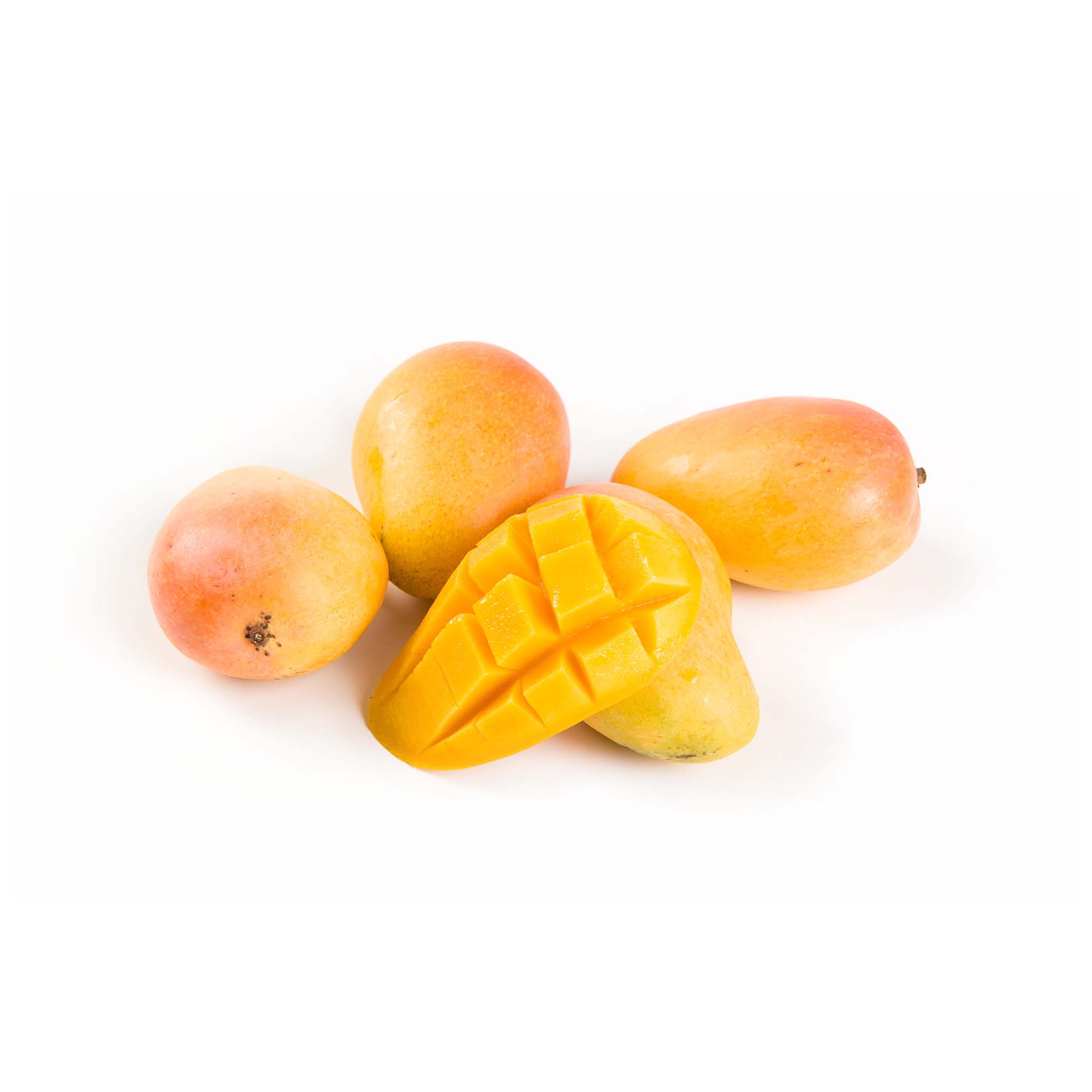
Alphonso-style: smaller, less fibrous, deeper orange, more aromatic. The mango people compare every other mango to. Score, scoop, eat — or halve and spoon out cold. One ripe baby mango is one breakfast, one dessert, or one of the better small decisions you'll make this week.
Ripening & storage
Climacteric — ripens off the tree- Ripeness cue
- Skin gives slightly under thumb; perfumed at the stem.
- Storage
- Room temp to soften; fridge 3–4 days once ripe.
About Baby mango
The baby mango is a small, rich-fleshed mango cultivar in the Alphonso/Ataulfo family — the line of cultivars that produced what most chefs and pastry kitchens consider the gold-standard mango. Each fruit weighs around 250–350g, with a deep orange-yellow skin and an even deeper saffron flesh inside.
Flavour and texture are both significantly above the standard table mango. The flesh is creamier, less fibrous, more honey-rich, with a strong floral aroma you can smell across a kitchen. There's still a stone in the centre, but it's smaller than the table-mango stone and the flesh-to-stone ratio is dramatically better.
Look for fruit that gives to gentle pressure and smells fragrant from the stem end. Slice along each flat side of the stone, score the flesh into a grid without piercing the skin, then push the skin up to invert the cubes. Eat straight, blend into lassi, or fold into yogurt with cardamom.
Did you know?
- Originated between north-west Myanmar, Bangladesh and north-east India — domesticated independently into Indian and Southeast Asian genetic types.
- Between 500 and 1,000 varieties are recognised globally — Alphonso, Kesar, Dasheri, Langra, Totapuri, Carabao and Ataulfo among the most traded.
- The mango is the national fruit of India, Pakistan and the Philippines, and the national tree of Bangladesh.
Sources: Wikipedia
How to eat
Below are the general steps that work across most kitchens. The description above is the source of truth for any cultivar-specific detail — cross-check before you cut.
1. Check ripeness
Use the cues in the description above. As a rule, exotic fruits do most of their ripening off the tree — give them a day or two at room temperature if they feel firmer than expected.
2. Wash and chill
Rinse under cold water, pat dry, and chill before serving. Cold flesh holds shape better when sliced and brings the aromatic notes forward.
3. Cut, scoop or peel
Follow the technique described above. If in doubt, halve crosswise with a sharp knife and taste a spoonful before committing to a full prep.
4. Pair simply
A squeeze of lime, a pinch of salt, or a drizzle of honey will lift almost any tropical fruit. Match strong cheese, cured meats or yoghurt for a board; keep flavours minimal when the fruit is the star.
From the Cashew family (mango): Slice along the flat of the stone, score the flesh into cubes, push the skin up to pop them out.
Buy this fruit
Sourced ripe and graded by hand. UK next-day delivery on every order placed before the daily cutoff.