


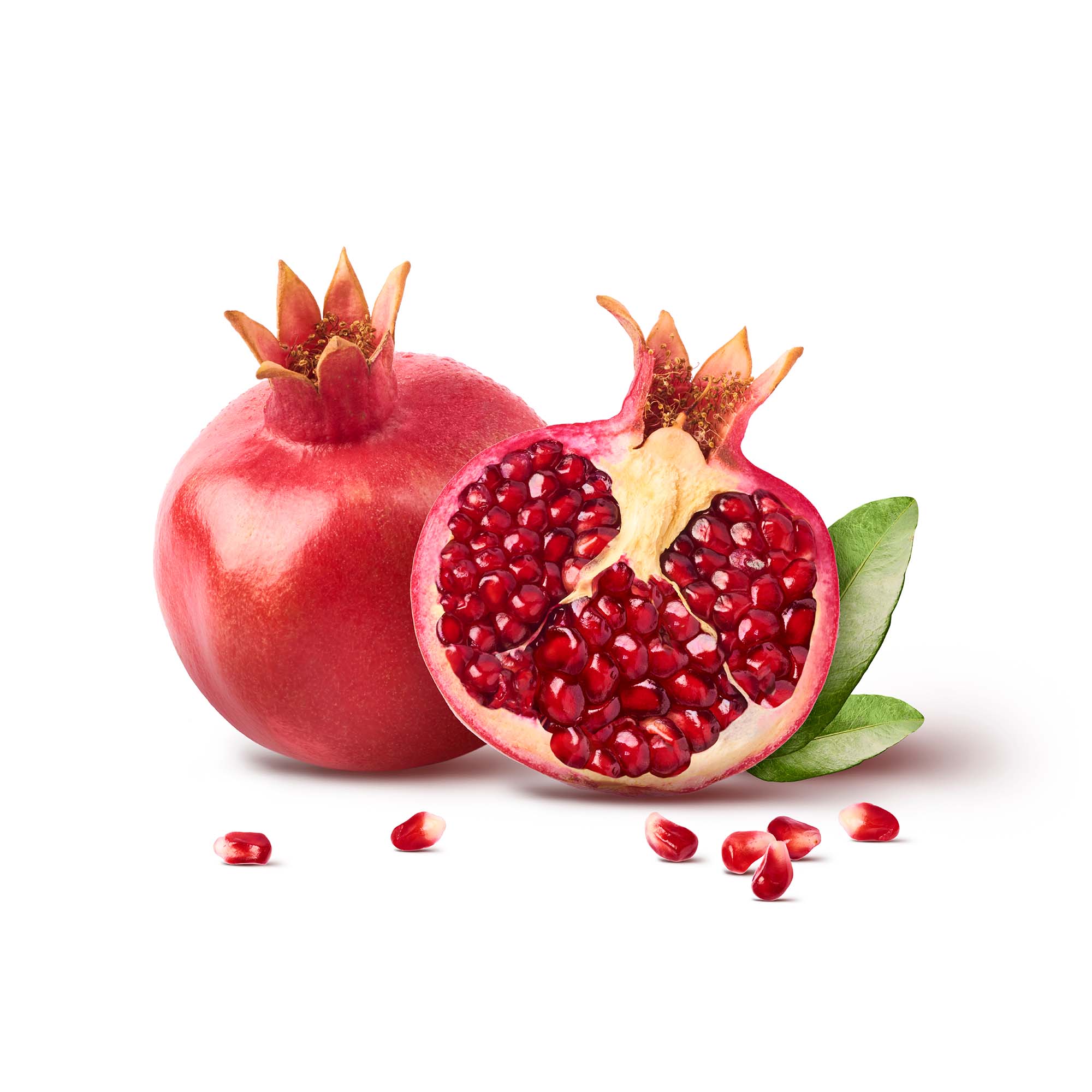
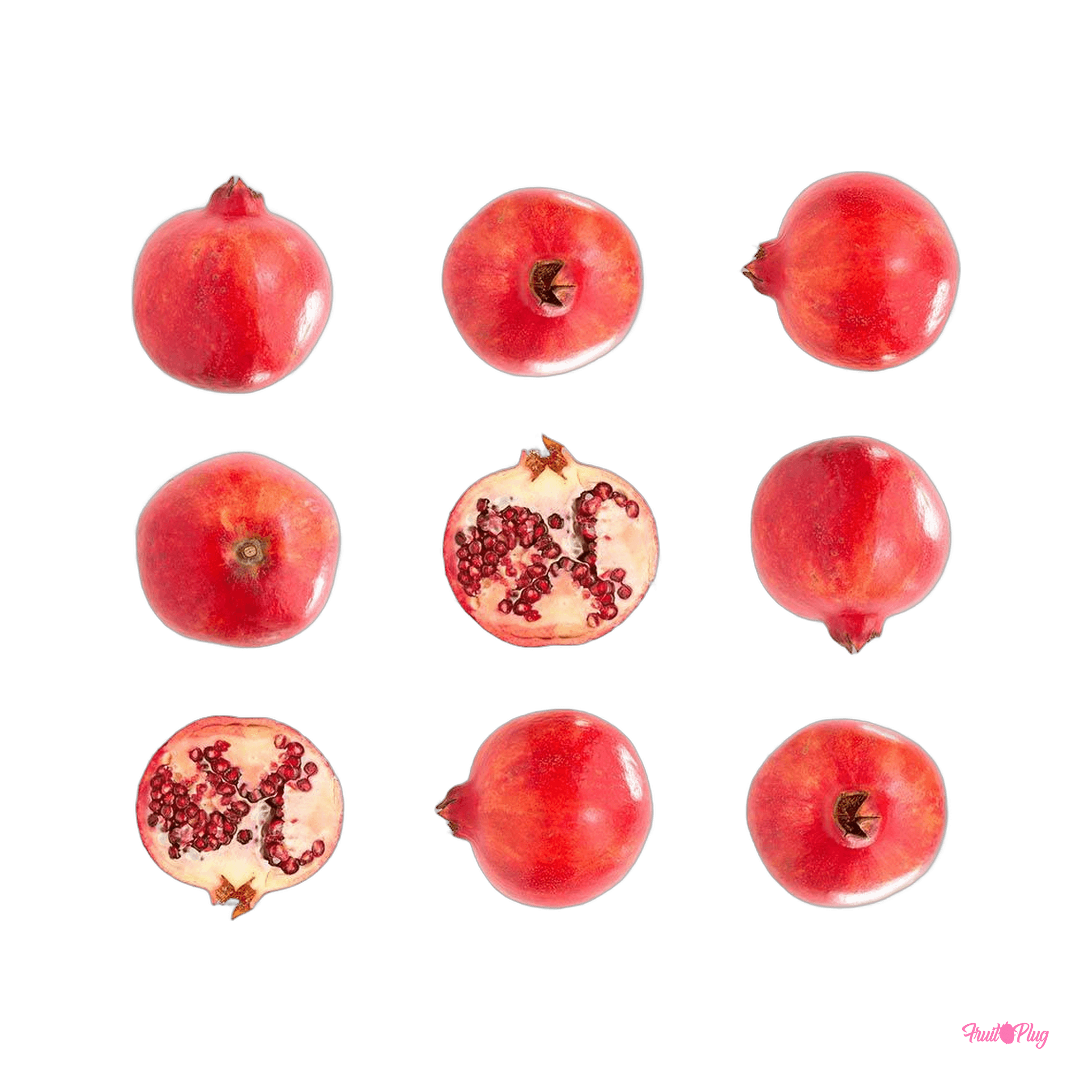
Hundreds of jewel-bright arils packed wall-to-wall under a leathery rind. Each one cracks between teeth into sweet-tart juice and a crunchy seed. The fruit that's been around since the Bronze Age — and there's a reason it's never gone out of fashion.
Ripening & storage
Non-climacteric — eat as-is- Ripeness cue
- Heavy for its size; skin starts cracking when fully ripe.
- Storage
- Cool dry spot for 2–3 weeks; arils freeze well for a year.
About Pomegranate
Pomegranate (Punica granatum) is one of the oldest cultivated fruits on earth — present in Egyptian tombs, Greek myth, Persian poetry and the Quran. The fruit is a leathery-skinned globe filled wall-to-wall with translucent ruby beads called arils, each containing a crunchy seed at its core.
Flavour is the perfect sweet-tart balance — fresh juice on the bite, a faint tannic edge, a clean finish. The seeds are entirely edible and add textural crunch. Heaviness is the best ripeness signal: a pomegranate should feel dense and hard for its size, with skin that's gone from pink to deep red-brown.
Score the skin around the equator and break it open under cold water — the arils sink, the white pith floats, and you can scoop the pith off the surface. Eat by the spoonful, scatter over salads, hummus or roast meats, or press for juice. Stores well in the fridge for up to a month whole.
Did you know?
- Domesticated around 5,000 years ago on the Iranian plateau and in the Caucasus — one of the oldest cultivated fruits on earth.
- Over 500 named cultivars exist, with skins ranging from yellow through every shade of red to deep purple.
- In Greek myth, pomegranate seeds bound Persephone to the Underworld each year — her absence is the ancient explanation for winter.
Sources: Wikipedia
How to eat
Below are the general steps that work across most kitchens. The description above is the source of truth for any cultivar-specific detail — cross-check before you cut.
1. Check ripeness
Use the cues in the description above. As a rule, exotic fruits do most of their ripening off the tree — give them a day or two at room temperature if they feel firmer than expected.
2. Wash and chill
Rinse under cold water, pat dry, and chill before serving. Cold flesh holds shape better when sliced and brings the aromatic notes forward.
3. Cut, scoop or peel
Follow the technique described above. If in doubt, halve crosswise with a sharp knife and taste a spoonful before committing to a full prep.
4. Pair simply
A squeeze of lime, a pinch of salt, or a drizzle of honey will lift almost any tropical fruit. Match strong cheese, cured meats or yoghurt for a board; keep flavours minimal when the fruit is the star.
From the Pomegranate family: Score the skin around the equator and break it open under water — arils sink, white pith floats.
Buy this fruit
Sourced ripe and graded by hand. UK next-day delivery on every order placed before the daily cutoff.