


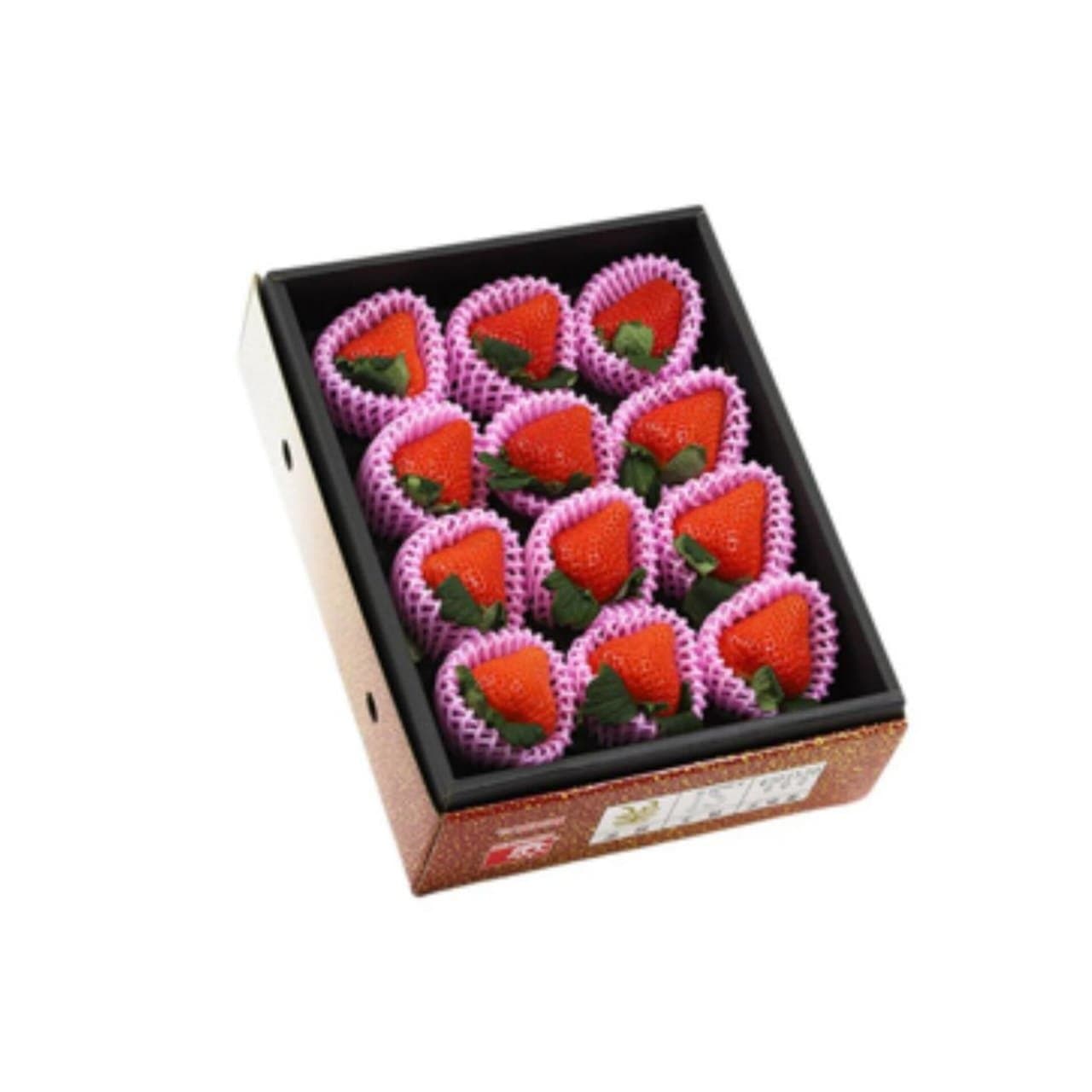
Japan's largest premium strawberry — each berry the size of a small peach, individually graded, individually wrapped. Deeply sweet, low in acid, with a perfumed finish that tastes engineered, because it is. Selected from Miyazaki growers and flown in to land in punnets the same week.
Ripening & storage
Non-climacteric — eat as-is- Ripeness cue
- Deep red all the way through to the stem; intensely fragrant.
- Storage
- Fridge immediately, eat within 2 days for peak flavour.
About Okimi Strawberry
The Okimi strawberry is a Miyazaki-bred premium cultivar of Fragaria × ananassa, selected over decades for size, sweetness and shelf-life. Each berry is graded by hand, individually positioned in the punnet, and presented at a quality level that Japanese culture associates with gift-giving rather than weekly shopping.
The headline is the size — single berries routinely run the size of a small peach — and the flavour matches the scale. Brix levels are noticeably higher than Western strawberries, the acidity is dialled back to almost nothing, and the perfume is closer to a confectioner's strawberry than the green-edged tang of a UK supermarket berry.
Serve at room temperature, ideally within 24 hours of arrival. No washing beyond a gentle pat — these aren't sprayed and bruise on contact. Eat whole, paired with chilled sparkling wine, mascarpone, or a single piece of dark chocolate. Best treated as the centrepiece, not a mix-in.
Did you know?
- Every dessert strawberry descends from a 1750s Brittany cross between North America's F. virginiana and Chile's F. chiloensis.
- Japan sustains a dedicated luxury-strawberry breeding tradition — Okimi is one of several prefecture-linked cultivars alongside Amaou and Tochiotome.
- Botanically, strawberries are not berries at all — each external 'seed' is an achene, its own tiny fruit dotted across the swollen red receptacle.
Sources: Wikipedia
How to eat
Below are the general steps that work across most kitchens. The description above is the source of truth for any cultivar-specific detail — cross-check before you cut.
1. Check ripeness
Use the cues in the description above. As a rule, exotic fruits do most of their ripening off the tree — give them a day or two at room temperature if they feel firmer than expected.
2. Wash and chill
Rinse under cold water, pat dry, and chill before serving. Cold flesh holds shape better when sliced and brings the aromatic notes forward.
3. Cut, scoop or peel
Follow the technique described above. If in doubt, halve crosswise with a sharp knife and taste a spoonful before committing to a full prep.
4. Pair simply
A squeeze of lime, a pinch of salt, or a drizzle of honey will lift almost any tropical fruit. Match strong cheese, cured meats or yoghurt for a board; keep flavours minimal when the fruit is the star.
From the Rose family (nashi pear, strawberry, apple): Eat cold and unpeeled where you can. Pairs naturally with blue cheese, prosciutto or a clean drizzle of honey.
Buy this fruit
Sourced ripe and graded by hand. UK next-day delivery on every order placed before the daily cutoff.